
Reflections on LCANZ Summit 2026: Communication, and Practice
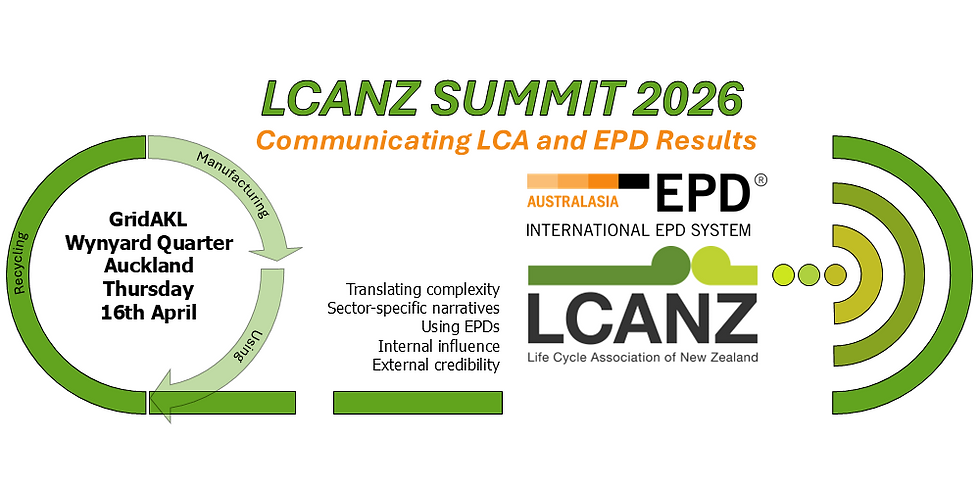
This year the LCANZ Summit 2026 centred a strong theme around communication, and not just how results are presented, but how they are can actually being used in practice.
Much of the discussion focused on what happens after the modelling is complete. Rather than the technical process of producing LCA or EPD outputs, the emphasis shifted towards how that information feeds into real decisions. This was evident from the opening presentation through to the later sessions, where the conversation consistently moved beyond methodology and into application.
Barbara Nebel set the tone early, highlighting the importance of defining the purpose of an LCA from the outset and being clear on who it is for. The same study can be used in multiple ways, but without that clarity, the outcome often does not meet expectations. That idea carried through the day, particularly in how results are communicated to different audiences. As quoted at the summit, “Understanding who our audience is helps make our LCA meaningful.”
Kelly Taylor and Andrew Moore from EPD Australasia reinforced the growing role of EPDs within the industry. With nearly 4,000 EPDs now published across Australia and New Zealand, and strong alignment with international standards, the focus is shifting from simply having an EPD to how it is used. Their discussion around verification pathways, digitalisation, and the movement towards automated tools highlighted how quickly this space is evolving, but also the need to maintain credibility as access to data increases.

At the same time, there was a level of honesty around how EPDs are being interpreted in practice. As Gustavo Moraga outlined, while the data within EPDs is robust, it is often misunderstood when used outside of a technical context. Comparisons are made without considering functional units, system boundaries, or life cycle stages, which can lead to conclusions that are not always accurate. This is not necessarily a flaw in the data itself, but a reflection of how it is being applied.
That point was reinforced by several speakers, including examples from manufacturers and consultants, where the challenge is no longer producing the data, but ensuring it can be understood and used appropriately. It highlights the growing need for clearer interpretation and communication alongside the technical output.
The importance of audience came through strongly. As shown in the WSP presentation, translating detailed LCA outputs into something that can be understood at an executive level requires a different approach. Their use of aggregated metrics to track carbon performance across projects demonstrated how complex information can be simplified to support decision making, without losing its intent.

Timing was another consistent theme. The ability to influence outcomes remains strongest in the early stages of a project, something that was clearly illustrated through both consultancy and product-based examples. Later-stage optimisation still has value, but the opportunity for significant reduction sits earlier in the process. Several speakers touched on the need for simplified approaches at these early stages, allowing decisions to be guided before full detail is available.
From an organisational perspective, the presentations from Fisher and Paykel Healthcare provided insight into how LCA is being scaled internally. Their approach to building reusable “building blocks” for common components and processes highlighted a practical way of improving consistency and efficiency across a large product range. It also demonstrated how internal structure and data management play a significant role in enabling LCA to be used more broadly within a business.
Similarly, Laminex shared a different challenge, focusing on how to manage change when a manufacturing process evolves. With significant investment into new production facilities, their current EPDs no longer fully represent the future state of their products. The discussion moved beyond the technical update of data and into how that transition is communicated to the market, particularly during periods where multiple product versions exist. It highlighted that LCA and EPDs sit within a wider business context, where communication and transparency are just as important as the data itself.
The session from New Zealand Winegrowers provided a broader perspective, showing how LCA principles can be applied at an industry level. Their focus on Scope 3 emissions, packaging impacts, and export-driven supply chains demonstrated how environmental data is being used to maintain market access and support brand positioning, particularly in international markets where sustainability expectations are increasing.
Energy and electricity modelling also formed part of the discussion, particularly in relation to market-based approaches and the use of renewable energy certificates. The presentation from Brave Trace highlighted how electricity sourcing can significantly influence LCA results, particularly in New Zealand where the residual grid mix can vary. It reinforced the importance of understanding how these factors are accounted for within assessments and communicated within EPDs.
Across the summit, there was no single approach that stood out as definitive. Different organisations are addressing similar challenges in different ways, depending on their scale, sector, and level of maturity. What is consistent, however, is the overall direction. There is a stronger focus on building internal structure, a greater emphasis on how data is used rather than simply produced, and increasing attention on communication as part of the process.
The value of the summit sat in seeing how these ideas are being applied in practice. It provided a clear view of where the industry is currently operating, what is working, and where further development is needed. As the tools and methodologies continue to evolve, the impact will increasingly depend on how effectively they are integrated into decision making.


